AI search is changing how people discover products, software, services, and brands.
In traditional search, businesses have focused on rankings, clicks, and website traffic. With AI-powered search, another question is becoming increasingly important:
Is AI recommending your brand when customers are deciding what to buy?
Being cited by an AI system can be valuable. A citation shows that your website or content was used as a source.
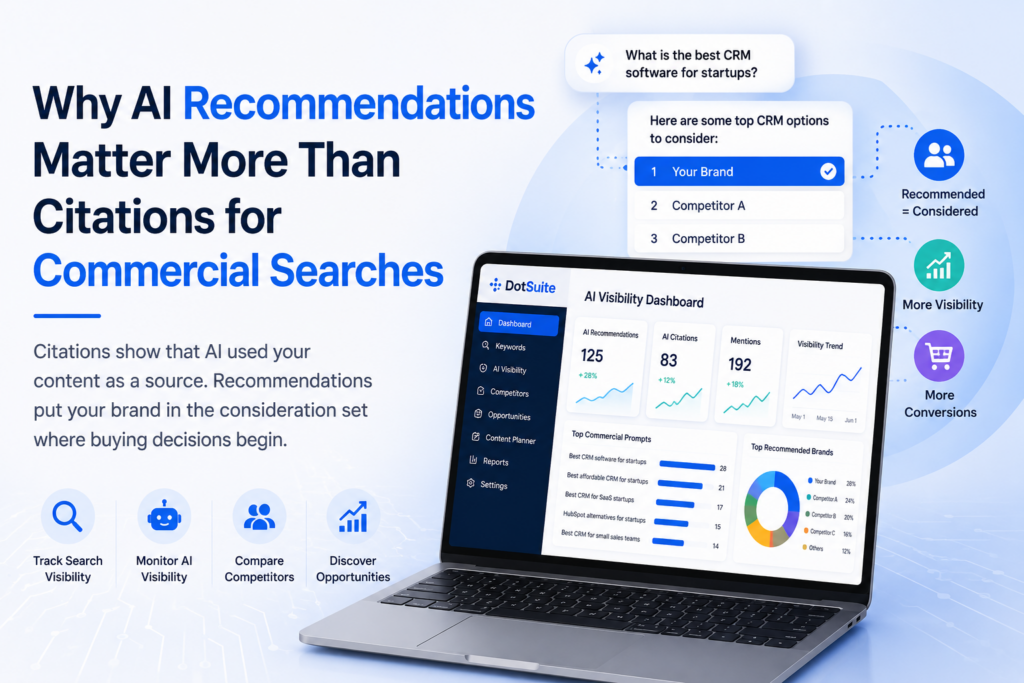
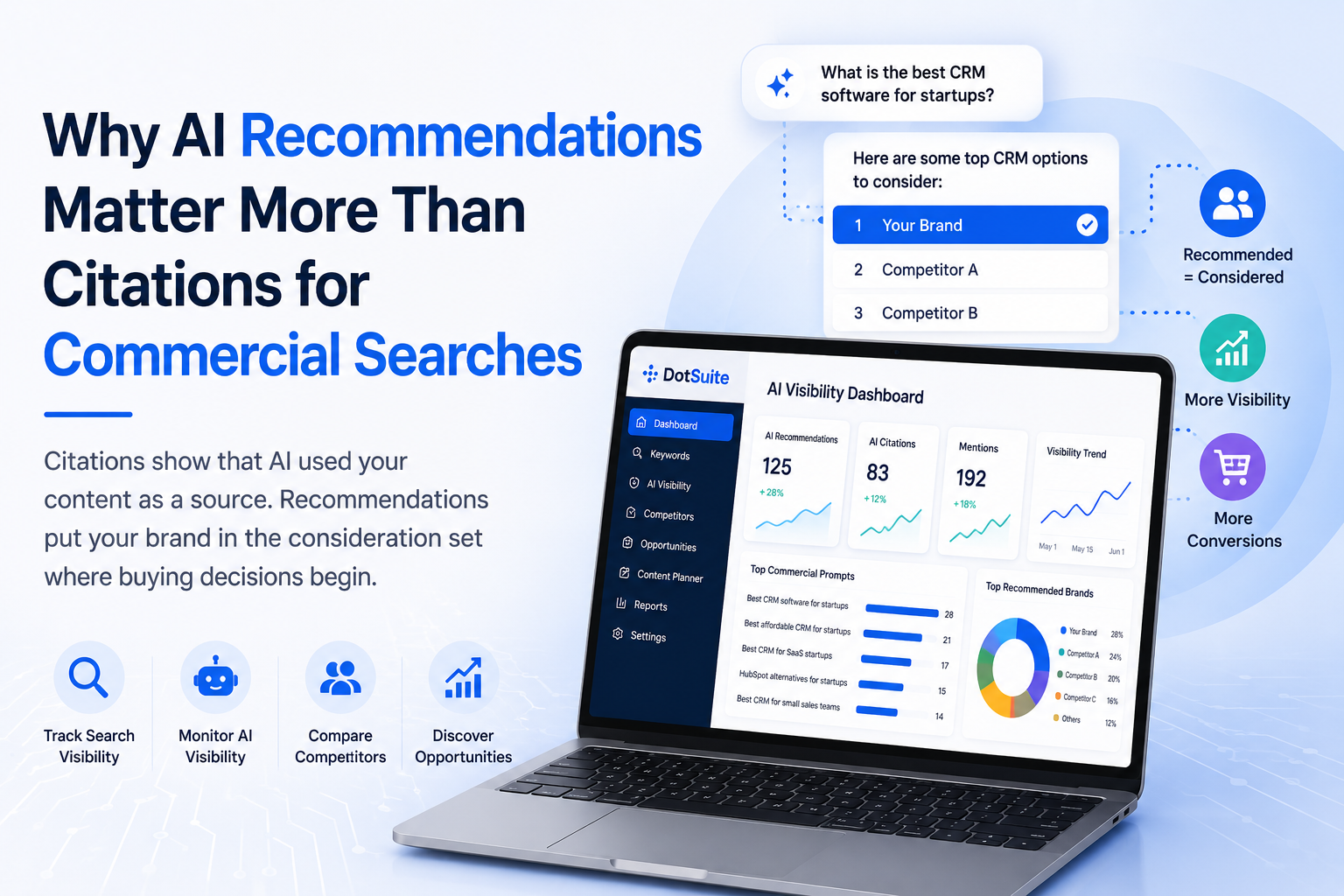
But for commercial searches, a recommendation can be even more valuable.
Consider a search such as:
“What is the best CRM software for startups?”
There is a major difference between your website being cited as a source and your CRM being recommended as one of the options.
A citation says: “This source is relevant.”
A recommendation says: “This is an option you should consider.”
For businesses competing for customers, that distinction matters.
What Is an AI Citation?
An AI citation is a reference to a website, article, research source, or other piece of information used to support an AI-generated answer.
For example, someone might ask:
“What should a startup look for in CRM software?”
An AI-generated answer might explain the importance of contact management, sales pipelines, automation, reporting, and integrations while referencing a CRM company’s website as a source.
That citation can be valuable.
It can indicate that the AI system considers your content relevant or useful for answering the question.
Citations can help with:
- Brand exposure
- Source visibility
- Content discovery
- Supporting AI-generated answers
- Establishing topical relevance
- Building awareness around your expertise
But a citation doesn’t necessarily mean that the AI system is recommending your business.
Your website could be cited while another CRM company is recommended.
That’s where the difference becomes important.
What Is an AI Recommendation?
An AI recommendation happens when an AI system presents a brand, product, service, or company as an option for the user to consider.
For example, someone might ask:
“What is the best CRM software for startups?”
An AI system could respond:
“For startups, options to consider include HubSpot, Pipedrive, Zoho CRM, and other CRM platforms depending on your budget and requirements.”
The companies mentioned in that list have become options in the buying decision.
They aren’t simply sources of information.
They’re being presented as products the user could evaluate.
That’s why recommendations are particularly important for commercial searches.
Citation vs. Recommendation
The simplest way to understand the difference is:
| AI visibility |
What it means |
| Mention |
Your brand appears in an AI answer |
| Citation |
Your website or content is referenced as a source |
| Recommendation |
Your brand or product is presented as an option |
| Consideration |
The user evaluates your brand against alternatives |
| Conversion |
The user becomes a customer |
These aren’t mutually exclusive.
A brand can be both cited and recommended.
In fact, strong content and authoritative sources can help support recommendation visibility.
But they represent different outcomes.
For commercial searches, the recommendation is often much closer to what the business ultimately wants.
Why Recommendations Matter More for Commercial Searches
Not every search has commercial intent.
Informational Search
“What is CRM software?”
The user primarily wants an explanation.
A citation from an authoritative CRM company or technology publication can be extremely useful.
Commercial Search
“What is the best CRM software for startups?”
Now the user’s intent is different.
They’re not simply asking what CRM software is.
They’re looking for options.
They may be comparing:
- Pricing
- Features
- Ease of use
- Sales automation
- Integrations
- Scalability
- Free plans
- Customer support
- Alternatives
The AI’s recommendation can therefore influence which CRM products enter the user’s consideration set.
The Difference Between Being a Source and Being an Option
Imagine a startup founder asks:
“What is the best CRM software for startups?”
Scenario 1: Citation
The AI answer says:
“A CRM helps startups manage leads, customer relationships, sales pipelines, and follow-ups.”
Your website is cited as a source for this explanation.
That’s useful.
Your content has been recognized as relevant.
But the founder may never consider your product.
Scenario 2: Recommendation
The AI answer says:
“For an early-stage startup looking for an affordable CRM, consider [Brand], [Brand], or [Brand].”
Now your company has entered the buying decision.
The founder knows:
Your brand → CRM software → Potential option
That’s a fundamentally different type of visibility.
A Citation Doesn’t Guarantee a Recommendation
This is one of the most important concepts for businesses entering AI search.
A website can be cited without being recommended.
Why?
Because AI systems can use different sources for different purposes.
One website might provide excellent educational information.
Another might have strong product information.
Another might be recognized as a useful comparison source.
Another brand might be selected as a recommendation.
Therefore:
Being cited does not automatically mean being recommended.
If your business objective is customer acquisition, you need to understand both.
Recommendations Put Your Brand in the Consideration Set
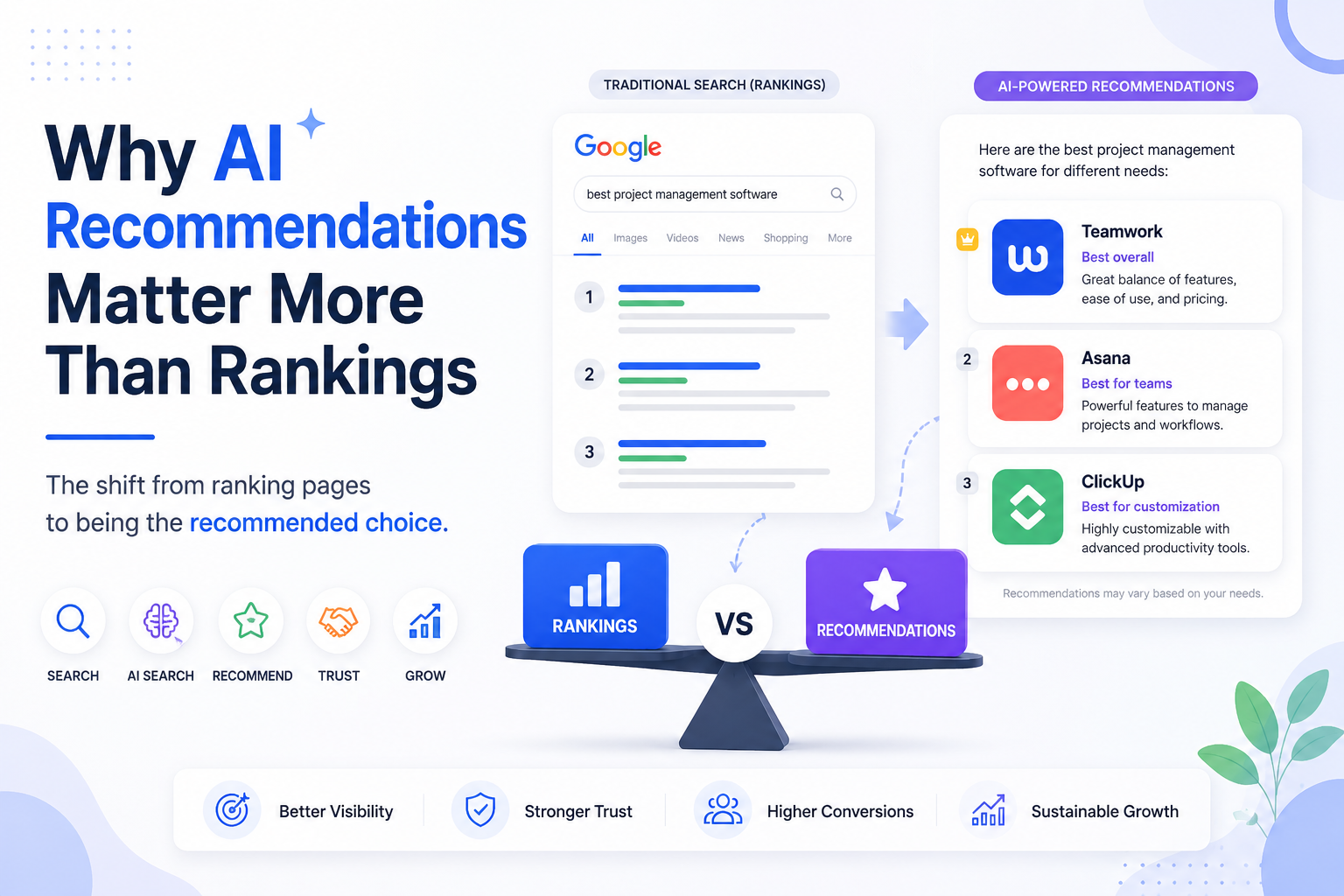
Traditional search marketing often focuses on getting a page onto the first page of Google.
Why?
Because visibility creates an opportunity for the user to click.
AI search introduces another possible path:
Prompt → AI Answer → Recommendation → Consideration
For commercial queries, getting into that consideration set can be extremely valuable.
Consider a startup founder searching:
“Best affordable CRM for a startup with a small sales team.”
The founder may receive several recommendations.
Those companies have now entered the user’s shortlist.
The founder may:
- Visit their websites
- Compare pricing
- Watch product demos
- Start free trials
- Talk to sales
- Read reviews
- Compare features
The AI recommendation has helped create the initial shortlist.
Recommendations Can Influence Product Discovery
AI search can become a product discovery channel.
A potential customer may not know your company before asking an AI system for recommendations.
For example:
“What are some affordable CRM platforms for a five-person startup?”
If your CRM is recommended, the AI system has introduced your product to someone who may never have searched for your brand by name.
This is different from branded search.
The customer isn’t searching for your company.
They’re searching the category or problem.
That means recommendation visibility can create opportunities for brands that aren’t already well known.
Recommendations Are Especially Important for “Best” Searches
Some of the most commercially valuable searches contain words such as:
- Best
- Top
- Affordable
- Recommended
- Alternatives
- Software
- Platforms
- For startups
- For small businesses
- For agencies
- For SaaS companies
- For sales teams
For example:
Best CRM software for startups
Best affordable CRM for small businesses
Best CRM for SaaS startups
Best CRM for a small sales team
Best HubSpot alternatives for startups
These searches aren’t simply asking:
“What is a CRM?”
They’re asking:
“Which CRM should I consider?”
That’s where AI recommendations become particularly important.
Commercial Intent Changes the Value of AI Visibility
The same type of AI visibility doesn’t have the same value for every search.
| Search intent |
Example |
Value of recommendation |
| Informational |
What is a CRM? |
Lower |
| Commercial investigation |
What is the best CRM for startups? |
High |
| Transactional |
CRM for startups with a free trial |
Very high |
The closer the search is to a buying decision, the more important recommendation visibility can become.
Competitor Recommendations Matter Too
AI recommendation tracking isn’t only about asking:
“Is my brand recommended?”
You also need to ask:
“Who is being recommended instead?”
Suppose you sell CRM software and track:
“Best CRM software for startups.”
Your brand isn’t recommended.
Three competitors are.
That’s not simply a visibility problem.
It’s an opportunity signal.
You can investigate:
- Which competitors are being recommended?
- Which prompts produce their recommendations?
- Which topics are associated with their visibility?
- What product attributes are mentioned?
- Which competitors appear repeatedly?
- Are you visible in Google Search for the same topics?
- Are you appearing in Google AI Overviews?
- Which commercial topics are you missing?
The recommendation itself becomes a starting point for analysis.
Recommendation Visibility Is Not Just About Counting Mentions
Suppose you track 1,000 AI prompts and discover that your brand appears 100 times.
Is that good?
It depends.
Were those appearances:
- Neutral mentions?
- Positive mentions?
- Citations?
- Recommendations?
- Comparisons?
- Alternatives?
- Negative references?
A simple mention count doesn’t tell the whole story.
A more useful AI visibility framework looks at how your brand appears.
Mention Visibility
How often does your brand appear?
Citation Visibility
How often is your website used as a source?
Recommendation Visibility
How often is your brand presented as an option?
Competitive Visibility
How often are competitors recommended instead?
This gives businesses a much clearer picture of their AI search presence.
Track the Prompts Your Customers Actually Ask
If you want to understand whether AI recommends your product, don’t only track informational questions.
Track the questions potential customers ask before making a purchase.
For a CRM company, that might include:
Category Searches
Best CRM software for startups
Budget Searches
Best affordable CRM for startups
Audience Searches
Best CRM for SaaS startups
Team-Size Searches
Best CRM for a small sales team
Feature Searches
Best CRM with sales automation
Comparison Searches
HubSpot vs Pipedrive for startups
Alternative Searches
Best HubSpot alternatives for startups
These prompts are often more commercially valuable than hundreds of unrelated AI questions.
The Goal Isn’t to Be Recommended Everywhere
More recommendations aren’t automatically better.
A recommendation only matters when it is relevant to your business.
If you sell CRM software, being recommended for:
“Best accounting software for small businesses”
doesn’t help.
The goal is to be visible for the right commercial searches.
Your most valuable prompts should be connected to:
- Your product
- Your customers
- Your category
- Your use cases
- Your competitors
- Your pricing position
- Your differentiators
- Your buying journey
Be recommended where your customers are actually making decisions.
Why Competitor Comparison Is Essential
AI recommendation visibility becomes much more useful when you can compare it with competitors.
Imagine you track several commercial CRM prompts:
| Commercial prompt |
Your brand |
Competitor A |
Competitor B |
| Best CRM software for startups |
✓ |
✓ |
✓ |
| Best affordable CRM for startups |
✓ |
— |
✓ |
| Best CRM for SaaS startups |
— |
✓ |
✓ |
| Best CRM for small sales teams |
— |
✓ |
— |
| Best CRM with sales automation |
✓ |
— |
✓ |
Now you have something actionable.
You can identify:
- Where you’re already strong
- Where competitors are stronger
- Where there are gaps
- Which commercial topics need attention
- Where new opportunities may exist
This is much more useful than simply knowing that your brand was mentioned a certain number of times.
From AI Visibility to Opportunity
The real value of AI search monitoring shouldn’t stop at reporting.
The more useful workflow is:
Search Visibility → AI Visibility → Compare Competitors → AI Copilot Identifies Opportunities → Identify Topics → Create with AI → Track Performance
This turns AI visibility into an ongoing growth process.
You’re not just asking:
“Did AI mention us?”
You’re asking:
“Where are we losing visibility, where are competitors winning, and what should we work on next?”
AI Copilot Can Help Identify Opportunities
Once you have search, AI visibility, and competitor data, the next challenge is interpretation.
There may be hundreds of keywords and prompts.
Which ones matter most?
Which competitor gaps are worth pursuing?
Which topics should be prioritized?
This is where an AI Copilot can help identify patterns and opportunities from the data.
For example:
Your competitors appear frequently for searches related to affordable CRM software for startups, while your brand has limited visibility.
That could lead to:
Opportunity → Affordable CRM for startups
Then:
Topic → Supporting content
Then:
Content → AI-assisted creation
Then:
Performance → Search + AI visibility tracking
The objective is to connect discovery with execution.
From Recommendation Opportunity to Content
Once you identify an important topic, the next step isn’t necessarily to create another generic article.
You need to understand the search intent.
For example:
“Best CRM software for startups”
might require a comparison page.
While:
“What is CRM software?”
might require an educational guide.
And:
“Best affordable CRM for startups”
might require a commercial comparison focused on pricing, features, and use cases.
The topic determines the content format.
AI can then help accelerate research, outlining, drafting, and content production.
But the strategy should come first.
Find the opportunity → identify the topic → create the right content → measure the result.
Why Search Visibility Still Matters
AI recommendations don’t replace traditional search visibility.
Google Search remains an important part of the discovery journey.
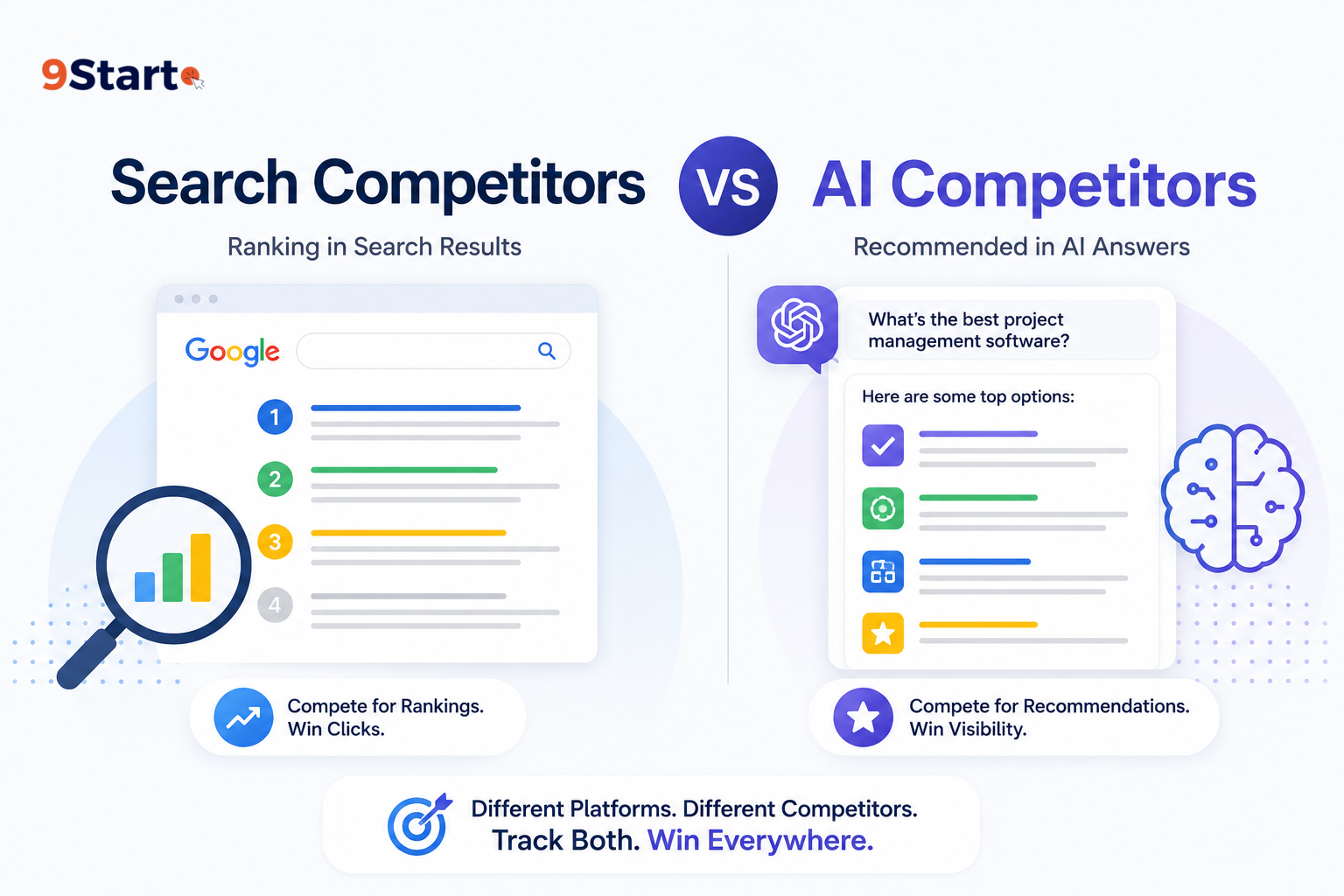
That’s why businesses should monitor both.
A modern search visibility strategy can include:
Google Search + Google AI Overviews + broader AI search platforms
Together, these provide a more complete picture of how a business is being discovered.
A brand might rank well organically but have limited AI recommendation visibility.
Another brand might have strong AI visibility but weak traditional search performance.
You want to understand both.
Where DotSuite Fits
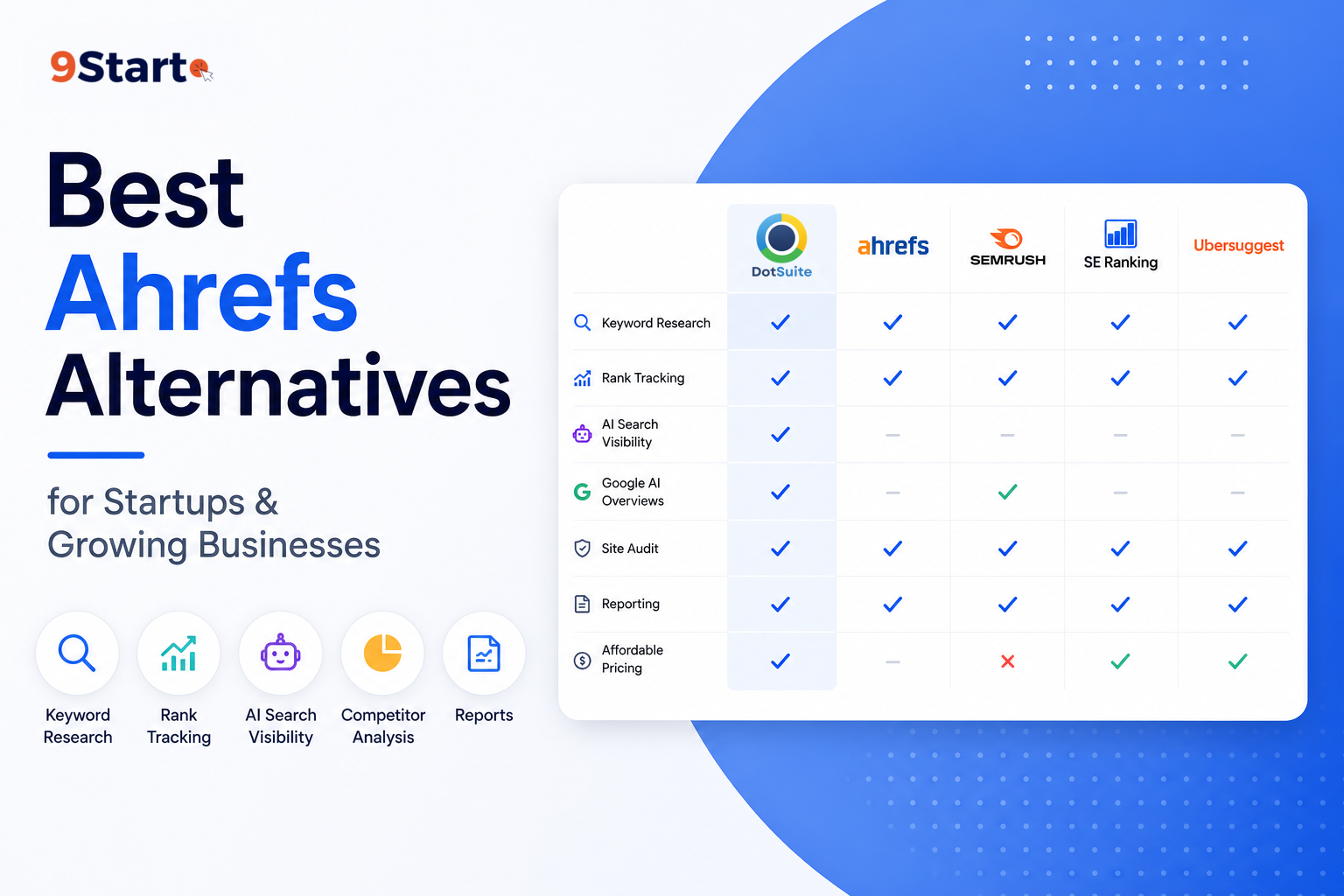
DotSuite is designed around this broader search and AI visibility workflow.
You can use DotSuite to monitor your Google Search visibility and Google AI Overview presence, compare competitors, and identify topics and search opportunities.
The workflow is:
Search Visibility → AI Visibility → Compare Competitors → AI Copilot Identifies Opportunities → Identify Topics → Create with AI → Track Performance
This moves the focus from simply collecting rankings or citations toward understanding where your brand has opportunities to become visible and competitive.
For businesses that need broader AI prompt tracking, the AI Visibility Tracker add-on extends monitoring to ChatGPT, Perplexity, and Gemini.
Start with Google
The standard DotSuite free trial focuses on:
- Google Search
- Google AI Overviews
Expand into broader AI visibility
The AI Visibility Tracker add-on provides broader AI prompt tracking across:
- ChatGPT
- Perplexity
- Gemini
What Should Businesses Track?
If you’re starting to measure AI recommendation visibility, begin with the searches that matter commercially.
For a CRM company, that might include:
Category
Best CRM software for startups
Budget
Best affordable CRM for startups
Audience
Best CRM for SaaS startups
Team Size
Best CRM for a small sales team
Use Case
Best CRM for managing startup sales
Comparison
HubSpot vs Pipedrive for startups
Alternative
Best HubSpot alternatives for startups
The same approach works across almost any commercial category.
A cybersecurity company might track:
Best cybersecurity software for startups
An accounting platform might track:
Best accounting software for small businesses
A project management platform might track:
Best project management software for startups
The principle is the same:
Track the questions your customers ask when they are deciding what to buy.
Citation or Recommendation: Which Should You Measure?
The answer is:
Both.
Citations can help you understand whether AI systems are using your content as a source.
Recommendations help you understand whether your brand is being presented as an option.
For commercial search, you ideally want to know:
- Are we being cited?
- Are we being mentioned?
- Are we being recommended?
- Which competitors are being recommended?
- For which commercial prompts are we missing?
That provides a much more complete picture of AI search visibility.
The Future of AI Search Visibility Is About Being Considered
The first generation of AI visibility conversations focused heavily on citations.
That’s understandable.
Citations are measurable and can indicate that an AI system has referenced a source.
But businesses ultimately care about something more fundamental:
Are potential customers discovering and considering our brand?
For informational searches, citations can be extremely valuable.
For commercial searches, recommendations can bring a brand much closer to the customer’s decision.
That’s why businesses should start thinking beyond:
“Are we cited?”
and begin asking:
“Are we recommended for the searches that matter?”
Start Tracking Your Search & AI Visibility
AI search is becoming another place where customers discover products, compare alternatives, and decide what to consider.
The opportunity isn’t simply to appear somewhere in an AI-generated answer.
It’s to understand where your brand is visible, where competitors are winning, and where you have opportunities to improve.
DotSuite connects that workflow:
Search Visibility → AI Visibility → Compare Competitors → AI Copilot Identifies Opportunities → Identify Topics → Create with AI → Track Performance
Start with a one-month free trial to evaluate your Google Search and Google AI Overview visibility.
When you need broader AI prompt tracking, add AI Visibility Tracker for ChatGPT, Perplexity, and Gemini.
Don’t just track where you’re cited. Track where you’re being considered.

 Free AI Visibility Check