For nearly twenty years, digital marketing revolved around one simple goal:
Rank higher on Google.
Every SEO strategy, content plan, backlink campaign, and website optimization project was designed to move one step closer to Position #1.
The logic was straightforward.
Higher rankings meant more visibility.
More visibility generated more clicks.
More clicks produced more leads.
And more leads grew the business.
That model transformed the digital marketing industry and created billions of dollars in value.
But something fundamental has started to change.
Consumers are no longer simply searching.
They’re asking.
Instead of typing:
Best CRM software
People now ask:
What’s the best CRM for a growing startup?
Instead of searching:
Best accounting software
They ask:
Which accounting software would you recommend for a small business with five employees?
Instead of comparing ten websites themselves, they’re asking AI to compare everything for them.
That’s a massive behavioral shift.
And it changes the objective of digital marketing.
The question is no longer only:
“Where do we rank?”
Increasingly, businesses should also ask:
“Would AI recommend us?”
Welcome to the AI Recommendation Economy
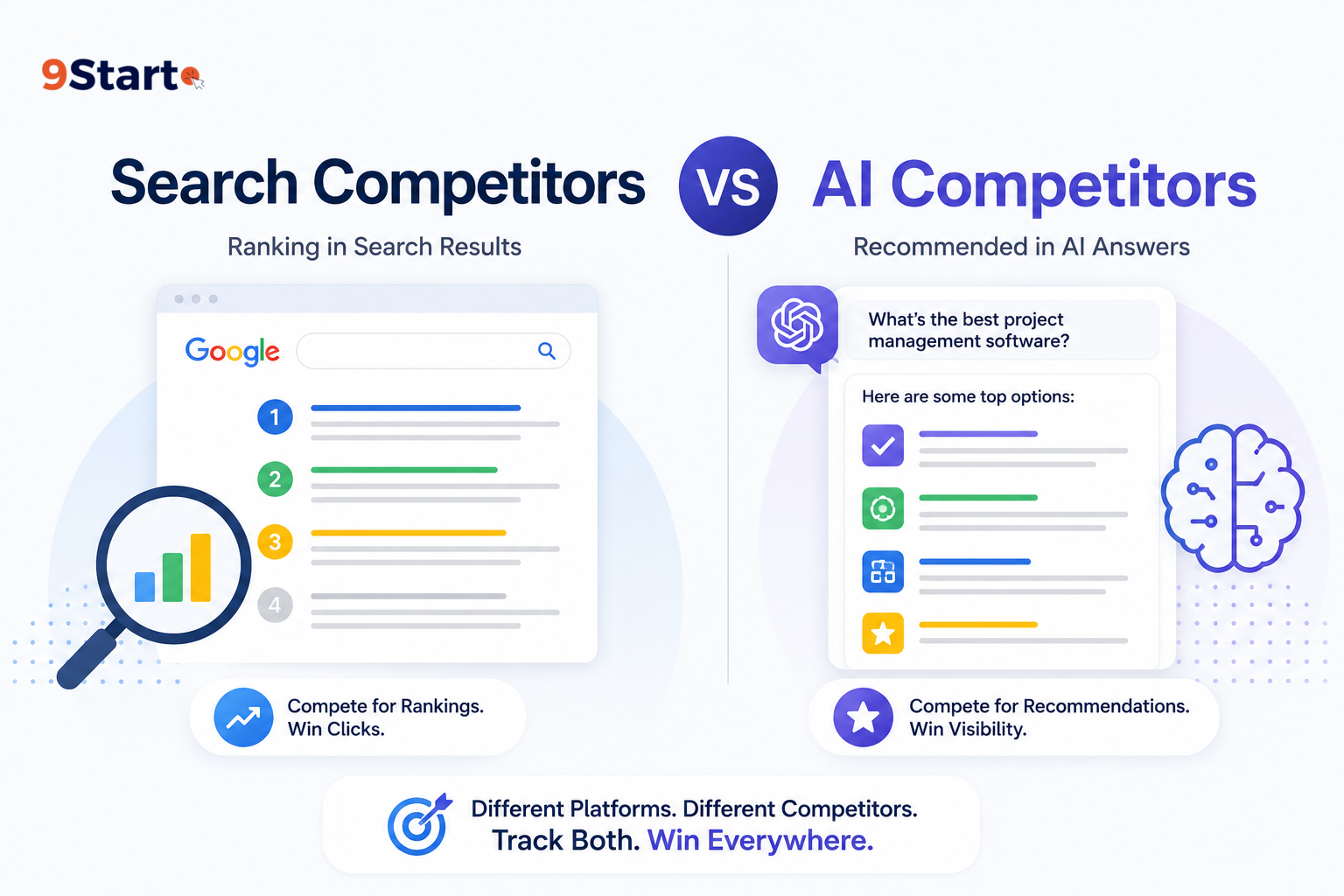
Search is evolving from an information retrieval system into a recommendation engine.
Traditional search engines acted like digital libraries.
They presented thousands of documents and allowed users to decide what was most relevant.
AI-powered search behaves differently.
Platforms like Google AI Overviews, ChatGPT, Gemini, Claude, and Perplexity increasingly summarize information, compare products, explain trade-offs, and recommend specific brands.
Instead of giving users ten links to explore, AI often provides just three to five recommendations.
That changes everything.
Visibility is no longer distributed across an entire search results page.
It becomes concentrated around a handful of trusted brands.
Businesses aren’t simply competing for rankings anymore.
They’re competing to become one of the brands AI chooses to recommend.
The Biggest Shift Since Google
Many marketers compare AI Search to the launch of Google.
In reality, the shift may be even larger.
Google changed how people found information.
AI is changing how people make decisions.
That’s an important distinction.
Traditional search required users to perform research.
AI increasingly performs research on behalf of users.
Instead of reading five comparison articles, customers ask AI to summarize everything.
Instead of evaluating ten software platforms, AI narrows the list to three.
The time between discovery and decision becomes dramatically shorter.
The Discovery Funnel Has Changed
For years, digital marketing followed a relatively predictable path.
Traditional Search
Keyword
↓
Google Ranking
↓
Website Visit
↓
Research
↓
Decision
↓
Customer
Businesses competed for rankings because rankings generated traffic.
AI Search introduces a different journey.
AI Search
Question
↓
AI Recommendation
↓
Brand Trust
↓
Website Visit
↓
Customer
Notice the difference.
Trust now exists before the website visit.
Instead of earning trust through your website alone, businesses increasingly borrow trust from AI recommendations.
If AI recommends your company, users arrive with far greater confidence.
That recommendation acts as a filter.
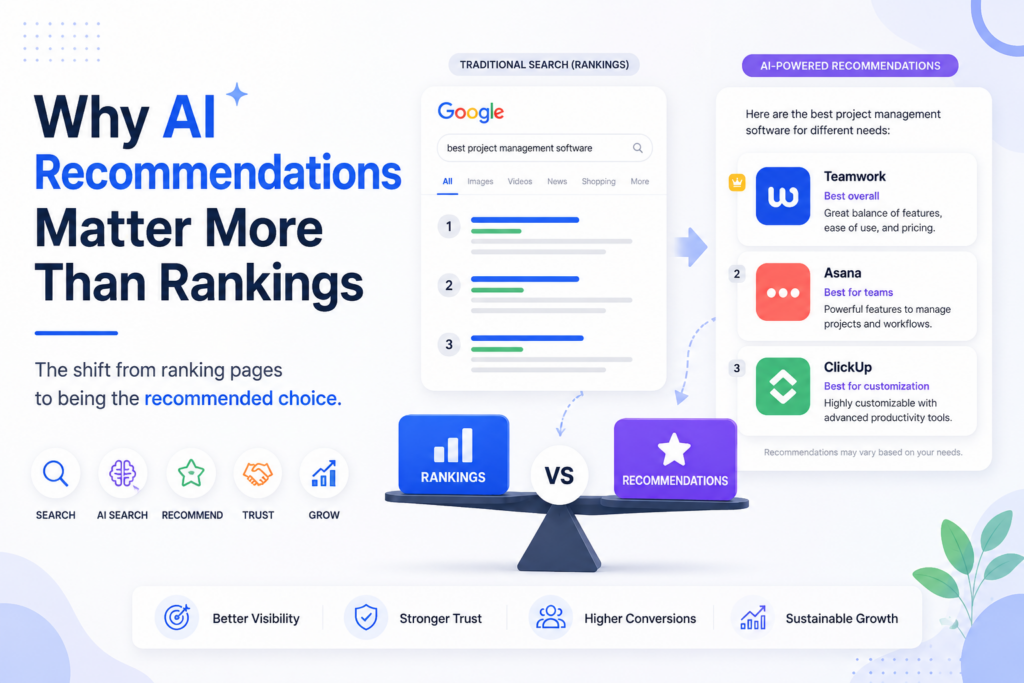
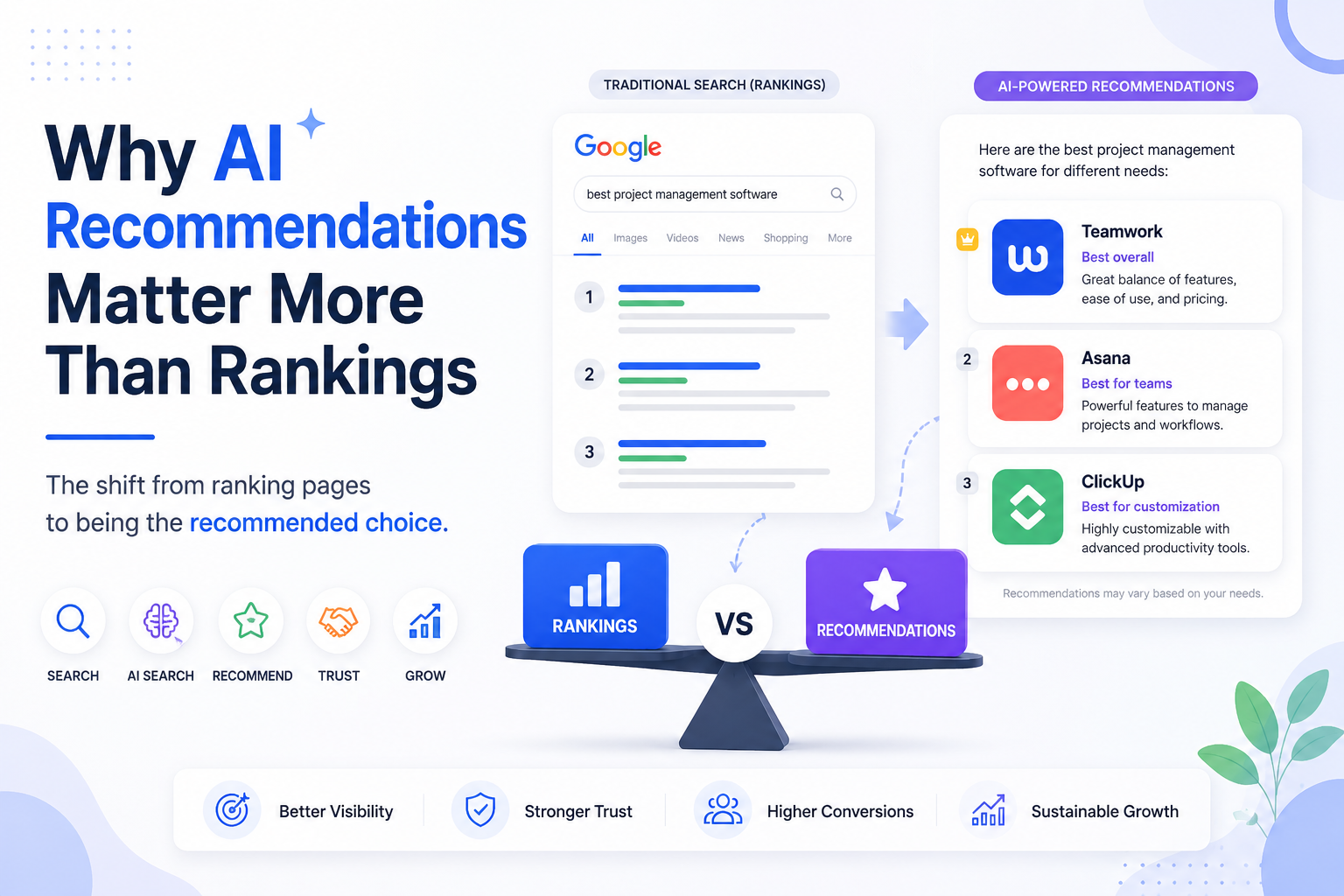
Rankings Get You Discovered. Recommendations Get You Chosen.
This may become one of the defining principles of modern search.
Google rankings still matter.
In fact, they’re often one of the strongest signals contributing to AI recommendations.
But rankings represent visibility.
Recommendations represent trust.
Imagine two businesses.
Company A ranks #2.
Company B ranks #6.
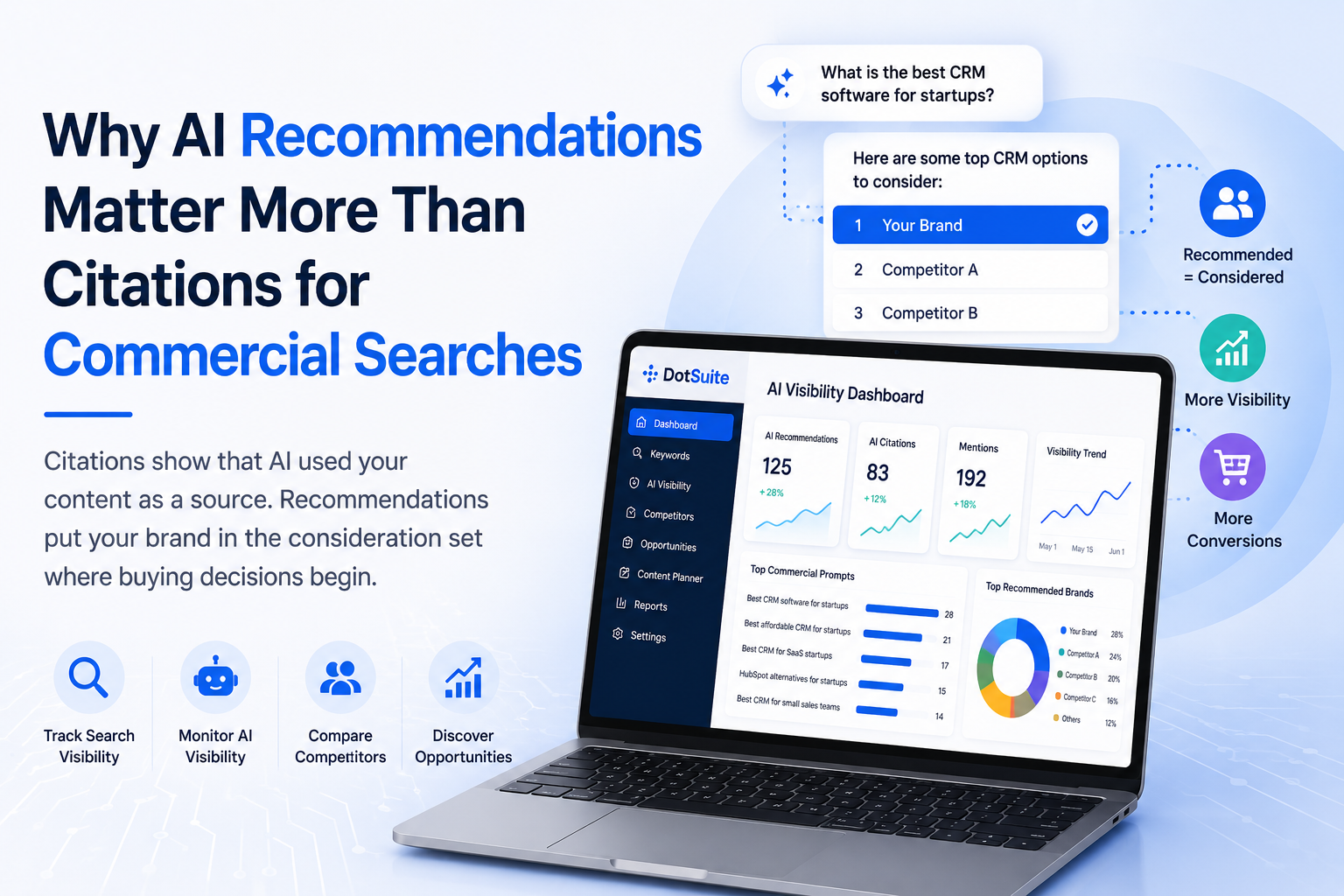
Now someone asks ChatGPT:
What’s the best CRM for startups?
If Company B is recommended and Company A isn’t, which business receives more attention?
The answer isn’t determined purely by rankings anymore.
It’s determined by whether AI considers your brand trustworthy enough to recommend.
Search Is Becoming Smaller
Traditional Google Search usually offers:
- 10 organic results
- Featured snippets
- Videos
- Images
- News
- Discussions
AI often reduces hundreds of pages into:
Three recommendations.
Sometimes four.
Occasionally five.
That makes every recommendation dramatically more valuable.
The future isn’t simply about appearing.
It’s about being selected.
Our Observations Across AI Platforms
Over the past several months, we’ve conducted numerous experiments comparing Google Search, Google AI Overviews, ChatGPT, and Gemini.
Although every AI platform uses different technologies, one pattern repeatedly appears.
The brands recommended by AI often share similar characteristics.
They usually have:
- Strong topical authority
- Consistent publishing history
- High-quality educational content
- Recognizable brand entities
- Broad online mentions
- Strong Google visibility
- Comprehensive topic coverage
Interestingly, many of these companies also perform well in traditional search.
That doesn’t necessarily mean Google rankings directly determine AI recommendations.
It suggests something more important.
Both search engines and AI systems reward similar signals of quality, authority, and trust.
Why Keywords Still Matter
One misconception we’ve seen repeatedly is the belief that AI Search eliminates the need for keywords.
Our observations suggest the opposite.
Keywords remain the foundation of discoverability.
They help businesses:
- Build topical authority
- Organize content clusters
- Strengthen entity recognition
- Expand semantic coverage
- Improve search visibility
Prompt optimization alone rarely explains why AI recommends one business over another.
The strongest recommendations usually originate from years of consistent content development around important keyword topics.
That’s why SEO continues to matter.
It’s simply evolving.
Recommendation Is the New Competitive Advantage
Imagine asking three different AI platforms:
Best project management software
You may notice something surprising.
Although each platform produces different wording, many recommend similar brands.
Why?
Because recommendation isn’t random.
AI tends to converge around companies demonstrating consistent authority.
That authority isn’t created overnight.
It’s earned through:
- Expertise
- Experience
- Trust
- Useful content
- Recognition across the web
Businesses that consistently invest in these signals become recommendation-worthy.
The New Marketing Question
For years, marketing dashboards asked questions like:
- What position do we rank?
- How many keywords improved?
- How much organic traffic increased?
Modern marketing teams should expand those questions.
They should also ask:
- Which AI platforms recommend us?
- How often are we cited?
- Which competitors appear instead?
- Which topics trigger recommendations?
- How visible are we across Search and AI Search?
These questions represent a broader view of digital visibility.
They measure something beyond rankings.
They measure discoverability.
Search Intelligence: The Next Evolution of SEO
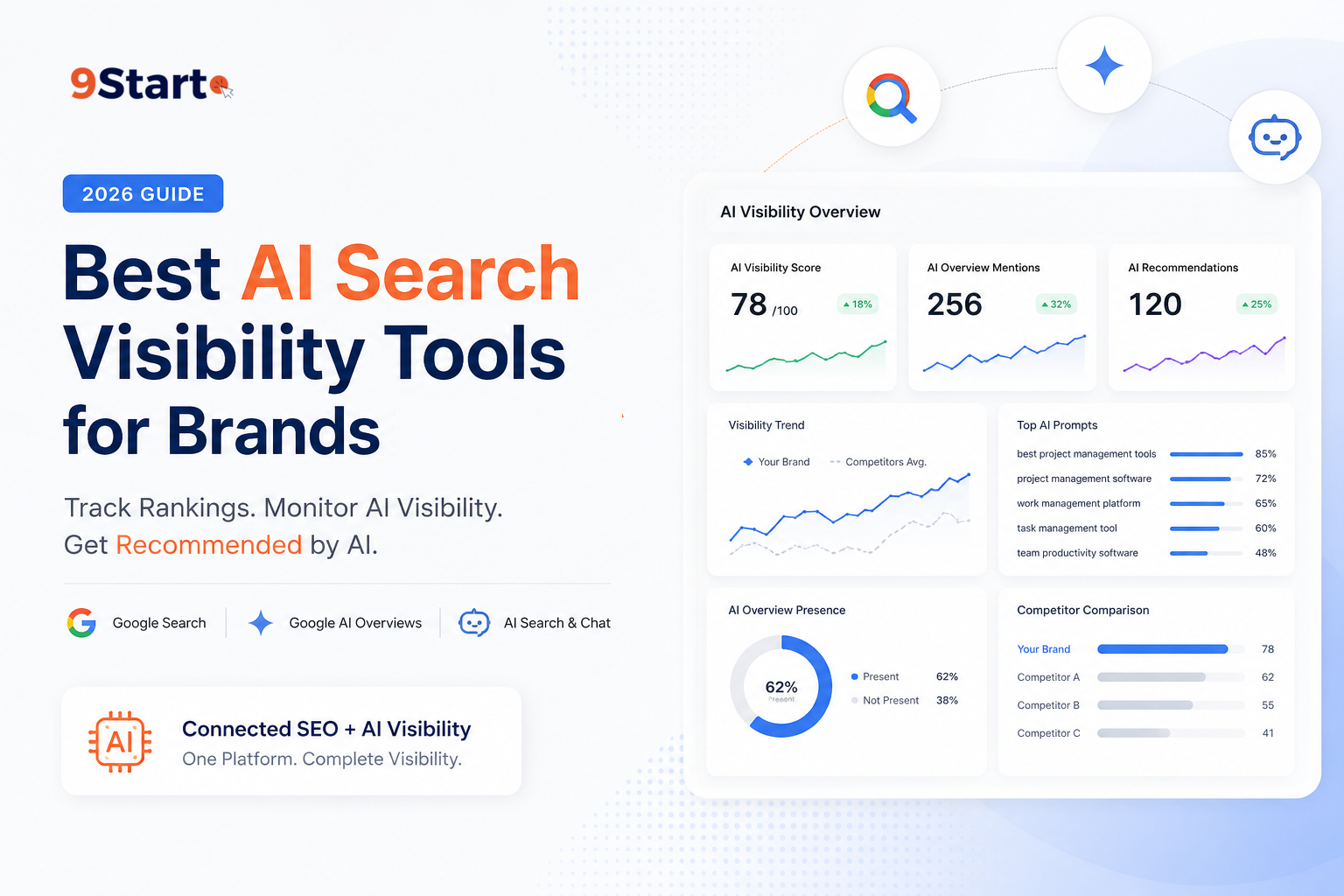
At 9Start, we believe businesses need a broader perspective than traditional rank tracking.
We call this Search Intelligence.
Search Intelligence brings together the signals that influence modern digital discovery, including:
- Traditional Google rankings
- Google AI Overviews
- AI-generated recommendations
- Topical authority
- Brand visibility
- Competitor analysis
- Entity recognition
- Content performance
Rather than treating SEO and AI Search as separate disciplines, Search Intelligence views them as part of the same ecosystem.
The brands that perform well over the next decade won’t optimize for one channel in isolation. They’ll build authority that translates across both traditional search engines and AI-powered experiences.
The Recommendation Flywheel
One of the biggest misconceptions about AI Search is that recommendations happen independently of SEO.
In reality, recommendations are often the outcome of years of building authority.
We call this The Recommendation Flywheel.
Helpful Content
        ↓
Better Rankings
        ↓
More Organic Visibility
        ↓
Greater Brand Recognition
        ↓
More AI Recommendations
        ↓
More Brand Searches
        ↓
More Authority
        ↓
Better Rankings
Unlike traditional SEO, which often focused on individual pages or keywords, AI Search rewards brands that consistently reinforce this cycle.
Every high-quality article strengthens your topical authority.
Every topic cluster expands your expertise.
Every mention across the web improves your entity recognition.
Over time, those signals increase the likelihood that AI systems consider your business a trustworthy recommendation.
Rather than chasing rankings alone, businesses should focus on strengthening the entire flywheel.
Recommendation Optimization: The Next Stage of SEO
For years, SEO was about optimizing webpages for search engines.
That objective hasn’t disappeared.
But AI-powered search introduces another layer.
Businesses now need to optimize for becoming recommendable.
At 9Start, we describe this as Recommendation Optimization.
Recommendation Optimization builds on traditional SEO rather than replacing it.
It combines:
- Keyword strategy
- Topical authority
- Content quality
- Entity development
- Brand consistency
- Digital trust
- Search Intelligence
- AI Visibility
The goal isn’t simply to appear in search results.
The goal is to become the answer AI confidently recommends.
Introducing Recommendation Rate
Traditional SEO reports answer questions like:
- How many keywords rank in the top 10?
- How much organic traffic increased?
- What is our average position?
These remain valuable metrics.
However, AI Search introduces new opportunities to measure visibility.
One concept businesses should begin tracking is Recommendation Rate.
Recommendation Rate represents:
The percentage of relevant AI conversations in which your business is recommended.
For example:
- 500 important customer questions
- Your business appears in 140 AI-generated answers
Recommendation Rate:
28%
While this isn’t yet a standardized industry metric, it illustrates how businesses can begin thinking beyond rankings and toward recommendation visibility.
Recommendation Share
Traditional SEO measures Share of Voice.
AI Search introduces another useful perspective:
Recommendation Share
Instead of measuring how often your pages rank, Recommendation Share looks at how frequently your brand is recommended compared to competitors across AI platforms.
Imagine asking 100 relevant questions across Google AI Overviews, ChatGPT, Gemini, Claude, and Perplexity.
If your competitors appear 60% of the time and your business appears only 15%, you have identified a significant opportunity—not necessarily because your rankings are poor, but because your authority and visibility in AI-generated responses can be strengthened.
Why Some Brands Appear Everywhere
Have you noticed that certain companies seem impossible to avoid?
Ask about CRM software.
HubSpot appears.
Ask about email marketing.
Mailchimp appears.
Ask about design software.
Canva appears.
This isn’t coincidence.
These companies have invested for years in:
- Comprehensive educational content
- Product documentation
- Comparison pages
- Topic clusters
- Brand recognition
- Industry leadership
As a result, AI systems repeatedly encounter reliable information associated with these brands.
That makes them safer recommendations.
The lesson isn’t that only large companies can succeed.
The lesson is that authority compounds over time.
Common Mistakes Businesses Make
As interest in AI Search grows, many businesses are looking for shortcuts.
Some common mistakes include:
Focusing only on prompt tracking
Tracking prompts can reveal useful insights, but it doesn’t improve visibility on its own.
Understanding why AI recommends competitors is far more valuable.
Ignoring traditional SEO
AI systems don’t operate in isolation.
Strong organic visibility, topical authority, and quality content remain essential.
Publishing thin AI-generated content
Large volumes of low-quality content rarely establish expertise.
Comprehensive, original, and genuinely helpful resources are far more effective.
Chasing every AI trend
The technologies will continue evolving.
Authority, trust, and expertise are likely to remain valuable regardless of which AI platform users prefer.
Building a Recommendation-Ready Brand
Businesses preparing for the future of search should focus on long-term authority rather than short-term tactics.
Key priorities include:
Build topical authority
Create comprehensive content around your core topics instead of isolated blog posts.
Develop recognizable entities
Help search engines and AI systems clearly understand your business, products, services, and expertise.
Publish original insights
Original research, experiments, frameworks, and case studies are more likely to earn citations and recommendations than generic content.
Strengthen internal linking
Topic clusters help both search engines and AI models understand relationships between concepts.
Maintain content quality
Helpful, well-structured, and accurate content continues to outperform thin pages.
Monitor both Search and AI
Traditional rankings remain valuable.
AI recommendations add another dimension.
Businesses need visibility across both.
SEO Isn’t Dead. It’s Expanding.
Every major shift in search has produced dramatic headlines.
Mobile was supposed to kill desktop SEO.
Voice search was supposed to replace traditional search.
Now AI Search is supposedly replacing SEO.
Reality is more nuanced.
SEO isn’t disappearing.
It’s evolving.
The businesses succeeding today are those that understand how traditional search and AI-powered search complement one another.
Rankings still drive visibility.
Authority still builds trust.
Content still educates customers.
AI simply changes how those signals are presented.
The Future of Search Intelligence
The next generation of marketing dashboards will likely look very different.
Instead of focusing exclusively on rankings and traffic, businesses will increasingly monitor questions such as:
- Which AI platforms recommend our business?
- Which competitors dominate AI recommendations?
- Which topics generate the strongest visibility?
- Where do Google rankings influence AI Overviews?
- How is our authority evolving over time?
This broader perspective is what we call Search Intelligence.
Search Intelligence combines traditional SEO metrics with AI Visibility to provide a more complete understanding of how customers discover brands in a changing search landscape.
Businesses that embrace this mindset today will be better positioned for tomorrow’s search experiences.
Final Thoughts
Search has always been about helping people find the information they need.
AI changes how that information is delivered, but not the importance of trust, expertise, and authority.
Google rankings remain one of the strongest foundations of online visibility.
However, being recommended by AI is becoming an increasingly important outcome of building that foundation.
Rather than asking only:
“Where do we rank?”
Businesses should also ask:
“Would AI recommend us?”
The companies that consistently create helpful content, develop topical authority, strengthen their brand, and invest in Search Intelligence will be best positioned to earn both rankings and recommendations.
In the years ahead, success won’t belong to businesses chasing algorithms.
It will belong to businesses earning trust.
About 9Start
Search is changing rapidly, and keeping up with both traditional SEO and AI-powered search requires more than occasional optimization.
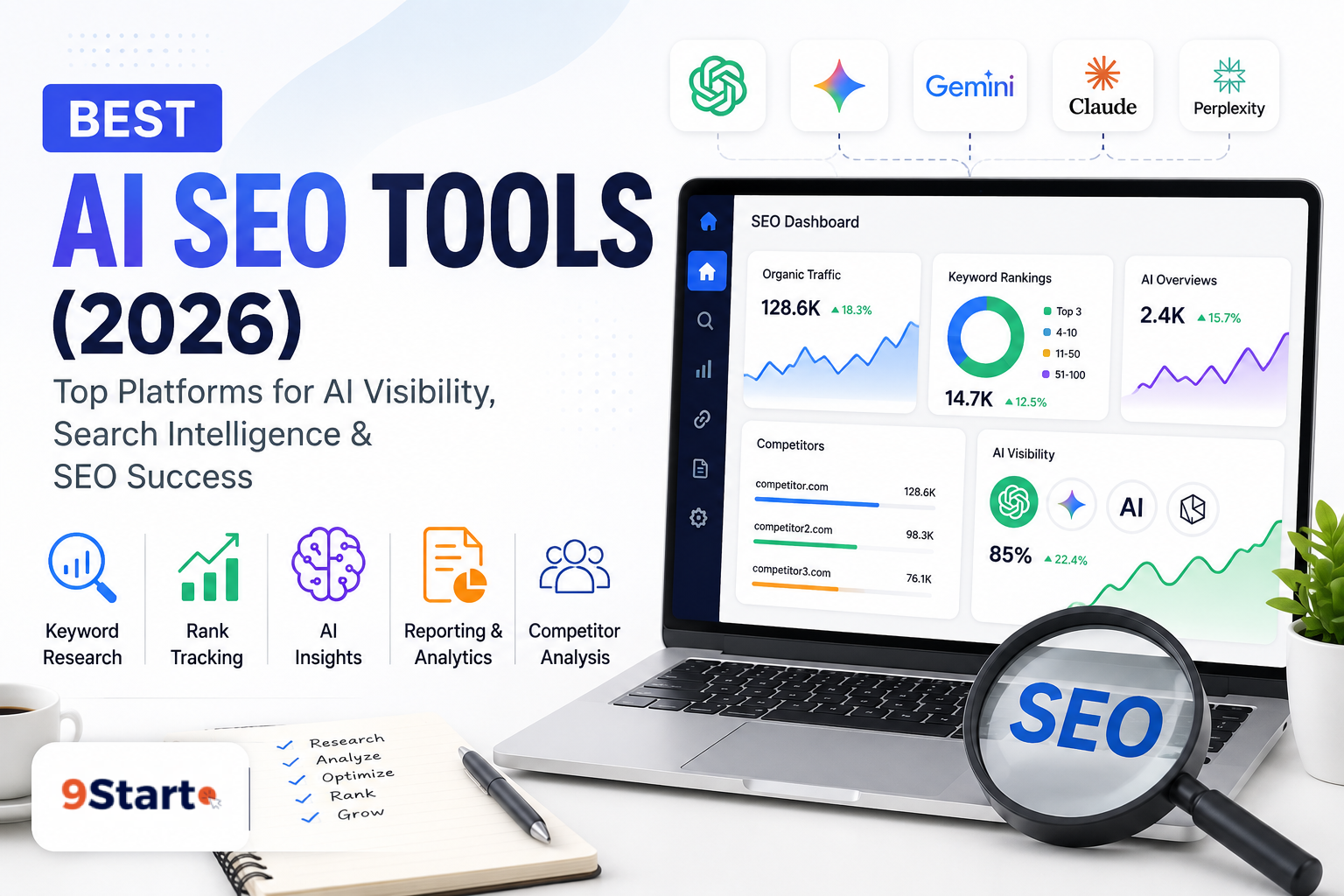
At 9Start, we help businesses improve how they’re discovered across Google Search, Google AI Overviews, ChatGPT, Gemini, Claude, Perplexity, and other emerging AI platforms.
Our services include:
- AI Search Strategy
- SEO Consulting
- AI Visibility Audits
- Search Intelligence
- Technical SEO
- Content Strategy
- Topical Authority Planning
- Competitor Analysis
- Entity & Knowledge Graph Optimization
- GEO (Generative Engine Optimization) Consulting
- AI Search Readiness Assessments
Whether you’re looking to increase organic visibility, strengthen your brand’s authority, or prepare for the future of AI-powered search, our team combines research, strategy, and practical execution to help you stay ahead.
Want to improve your visibility across both Search and AI?
Get in touch with 9Start to discuss your SEO, AI Visibility, and Search Intelligence goals, and build a strategy designed for the next generation of search.

 Free AI Visibility Check