AI search has created a new problem for marketers.
It’s no longer enough to know:
“Where does my website rank on Google?”
Brands increasingly want to know:
“When customers ask AI-powered search for recommendations, is my brand being mentioned, cited, or recommended?”
That has created a rapidly growing category of AI Search Visibility, GEO, and AEO tools.
But there’s an important distinction between tracking AI prompts and actually understanding your overall search visibility.
If a brand wants to build sustainable visibility across Google Search and AI search, tracking keywords, rankings, competitors, content, context, and AI prompts together can provide a much more complete picture.
This guide compares some of the leading approaches to AI search visibility in 2026 and explains why DotSuite takes a different approach by connecting traditional SEO and AI visibility in one platform.
What is AI Search Visibility?
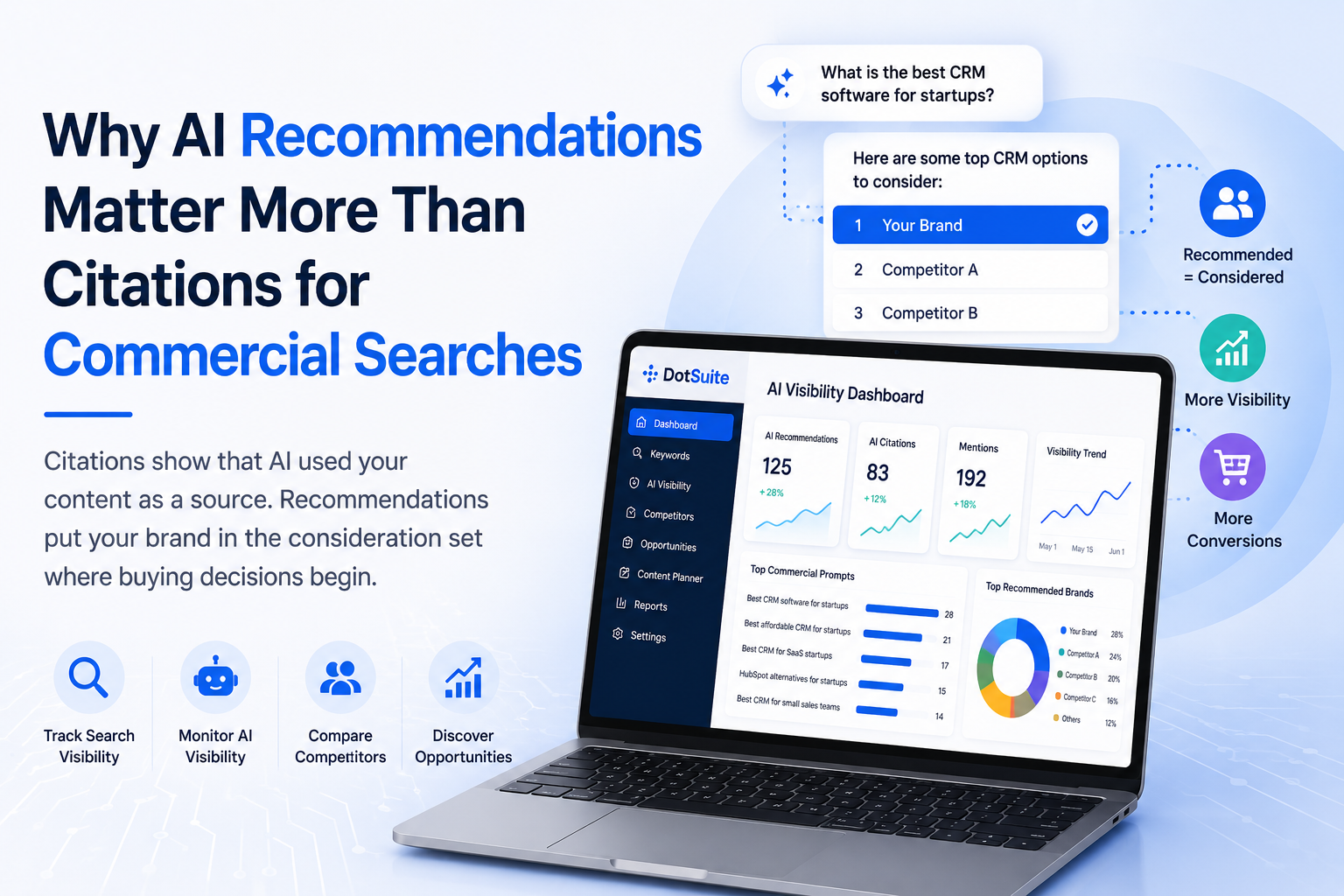
AI search visibility refers to how frequently and prominently a brand appears in AI-powered search experiences.
This can include:
- Brand mentions
- Citations
- AI-generated recommendations
- Google AI Overviews
- AI search prompts
- Competitor mentions
- Sources referenced by AI
- Changes in visibility over time
AI visibility tools typically allow marketers to create a set of prompts and monitor how AI systems respond.
That is useful.
But prompt tracking alone doesn’t tell the entire story.
Why keywords still matter in the age of AI search
One of the biggest misconceptions about AI search is that keywords no longer matter.
They do.
The way people search is changing, but keywords remain the foundation for understanding topics, demand, intent, content, and competitive positioning.
Consider:
Keyword:
best CRM software
That keyword can expand into dozens of contexts:
- Best CRM for startups
- Best CRM for small businesses
- Affordable CRM software
- CRM alternatives to Salesforce
- Best CRM for sales teams
- Easiest CRM to implement
The keyword provides the topic.
The context provides the intent.
The prompt represents the question.
And AI visibility tells you what happens when that question is answered.
That’s why we believe the modern workflow should look more like:
Keyword → Context → Prompt → Google Search → AI Search → Competitor → Recommendation
Rather than simply:
Prompt → Mention / No Mention
The AI Search Experiment: Google, ChatGPT and Gemini
A recent experiment published by 9Start provides an interesting perspective on this relationship.
The experiment compared the results for the same commercial query across:
- Google Organic Search
- Google AI Overviews
- ChatGPT
- Gemini
The researchers found considerable overlap between the brands appearing across these different experiences.
The experiment’s conclusion isn’t that Google rankings automatically determine AI recommendations. Instead, it raises a more interesting possibility: traditional SEO, content authority, brand recognition, and search visibility may continue to influence the broader ecosystem from which AI recommendations emerge.
Read the full AI Search Experiment on 9Start
This is why simply tracking AI prompts can be insufficient.
You also need to understand the search ecosystem behind those prompts.
The best AI visibility tools aren’t all solving the same problem
The AI visibility market has grown rapidly in 2026.
Current comparisons include platforms such as Profound, Peec AI, Otterly, Semrush, Ahrefs, AthenaHQ, and other specialised AI visibility products. Pricing ranges from relatively inexpensive monitoring tools to enterprise platforms costing hundreds or thousands of dollars per month.
The important thing is that these products aren’t necessarily direct substitutes.
Some are built primarily for:
- AI prompt monitoring
- Enterprise AI visibility
- Citation analysis
- GEO analytics
- Traditional SEO
- Large-scale keyword research
And some attempt to connect several of these workflows.
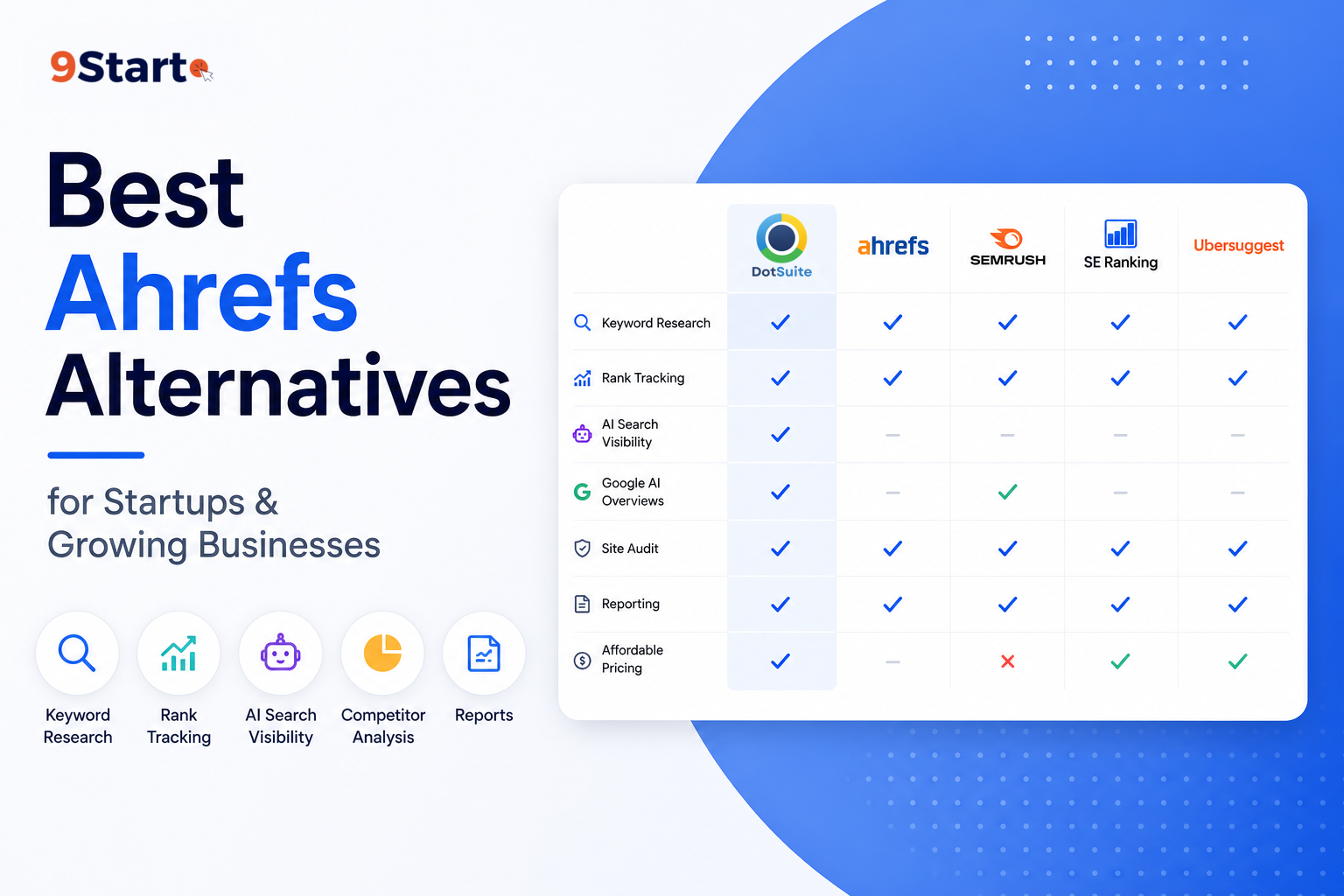
AI Search Visibility Tools Compared
| Platform |
Primary focus |
Traditional SEO |
AI visibility |
Google AI Overviews |
Competitor insights |
Prompt tracking |
Recommendations |
Connected SEO + AI workflow |
| DotSuite |
Search + AI visibility intelligence |
✓ |
✓ |
✓ |
✓ |
✓ |
AI Growth Copilot |
✓ |
| Semrush |
Comprehensive SEO suite + AI visibility |
✓ |
✓ |
✓ |
✓ |
✓ |
✓ |
✓ |
| Ahrefs |
SEO / web intelligence + AI discovery |
✓ |
✓ |
✓ |
✓ |
✓ |
Limited/varies |
✓ |
| Otterly |
AI search monitoring |
Limited |
✓ |
✓ |
✓ |
✓ |
GEO recommendations |
Primarily AI-focused |
| Peec AI |
AI visibility / GEO analytics |
Limited |
✓ |
✓ |
✓ |
✓ |
Analytics/recommendations |
Primarily AI-focused |
| Profound |
Enterprise AI visibility |
Limited |
✓ |
Varies by plan |
✓ |
✓ |
Advanced |
AI-focused |
| AthenaHQ |
AI visibility + optimisation |
Limited |
✓ |
✓ |
✓ |
✓ |
✓ |
AI-focused |
Feature availability and pricing can change. Verify current plan details with each vendor before purchasing. The table is intended to illustrate product positioning rather than claim that one platform universally outperforms another.
Current 2026 comparisons show, for example, Otterly starting around $29/month, while Peec, Profound, Semrush’s AI visibility offering, and Ahrefs’ AI products occupy considerably higher price points depending on usage and plan.
So what makes DotSuite different?
DotSuite’s approach is different from a pure AI prompt tracker.
Instead of asking only:
“Does AI mention my brand?”
DotSuite connects:
Search → Keywords → Competitors → Context → Prompts → AI Visibility → Recommendations
This means a marketer can start with traditional SEO data and move into AI search without changing platforms.
For brands trying to build visibility across both channels, that connection is important.
DotSuite offers three ways to approach Search + AI visibility
One of the useful aspects of DotSuite is that businesses can choose the level of intelligence they need.
Search
For businesses focused primarily on traditional SEO.
Track:
- Keywords
- Rankings
- Search visibility
- Organic performance
- Competitors
- Pages and content opportunities
AI
For businesses specifically looking to understand their AI search presence.
Track:
- AI visibility
- AI mentions
- AI search prompts
- AI recommendations
- Google AI Overviews
- Competitor AI visibility
Search + AI
For businesses that want the complete picture.
Connect:
Google Search + SEO + Keywords + Competitors + Context + Prompts + AI Visibility + Recommendations
This is where DotSuite becomes particularly useful.
Instead of adding an AI visibility platform on top of an existing SEO stack, the two workflows are designed to work together.
Why “AI mentions” aren’t enough
Imagine your brand isn’t appearing for an important AI prompt.
A standalone AI visibility tool might tell you:
Visibility: 0%
That’s useful information.
But the next question is:
Why?
Maybe your competitor ranks higher for the underlying keyword.
Maybe your competitor has stronger topical coverage.
Maybe the competitor’s content answers the specific context better.
Maybe your page doesn’t cover related questions.
Maybe the AI system is sourcing a completely different type of content.
That’s where connecting AI visibility with traditional search and competitor intelligence becomes valuable.
From competitor gap to AI recommendation
Suppose a competitor appears consistently for a group of relevant prompts.
With a disconnected workflow, you’d typically:
- Find the prompt
- Identify the competitor
- Search for the competitor’s page
- Research their keywords
- Compare content
- Identify gaps
- Create a strategy
DotSuite is designed to connect those steps.
You can move from competitor comparison and keyword overlap toward identifying the opportunity and generating an actionable strategy.
This is where AI Growth Copilot fits into the workflow.
Instead of simply reporting:
“Your competitor is more visible.”
the goal is to answer:
“What should we do next?”
Why Google AI Overviews matter
AI visibility isn’t limited to ChatGPT.
Google itself is changing the search experience through AI Overviews, making it increasingly important for brands to understand how their visibility behaves inside Google’s AI-generated results as well as traditional organic listings.
A modern AI search visibility strategy should therefore consider:
Google Search
Google AI Overviews
AI-powered search experiences
rather than monitoring only one environment.
DotSuite brings Google Search tracking and AI visibility tracking together so marketers can understand these signals in the same workflow.
What about the cost?
This is where the market becomes particularly interesting.
AI visibility tools range from roughly $29/month at the low end to hundreds of dollars per month, while enterprise solutions can cost considerably more depending on usage, engines, prompts, seats, and other limits. Current 2026 comparisons show significant differences in how vendors meter usage.
For a startup or growing brand, buying:
SEO platform + AI visibility platform + competitor platform + recommendation tool
can quickly become expensive.
DotSuite’s approach is to provide Search, AI, and Search + AI plans, allowing businesses to choose the workflow they actually need rather than immediately building a large multi-tool stack.
Which AI Search Visibility Tool Should You Choose?
There isn’t one universally best AI visibility platform.
The right choice depends on your requirements.
Choose an enterprise-focused platform if:
You need extensive enterprise governance, compliance, large-scale monitoring, and advanced organisational workflows.
Choose a dedicated AI visibility platform if:
Your primary requirement is monitoring AI prompts, mentions, citations, and AI search performance.
Choose a comprehensive SEO suite if:
Your organisation already depends heavily on a large SEO platform and wants AI visibility added to that existing ecosystem.
Choose DotSuite if:
You want Google Search + SEO + AI visibility + competitor intelligence + prompt discovery + actionable recommendations in one connected platform, particularly as a startup, growing business, marketing team, agency, or consultant.
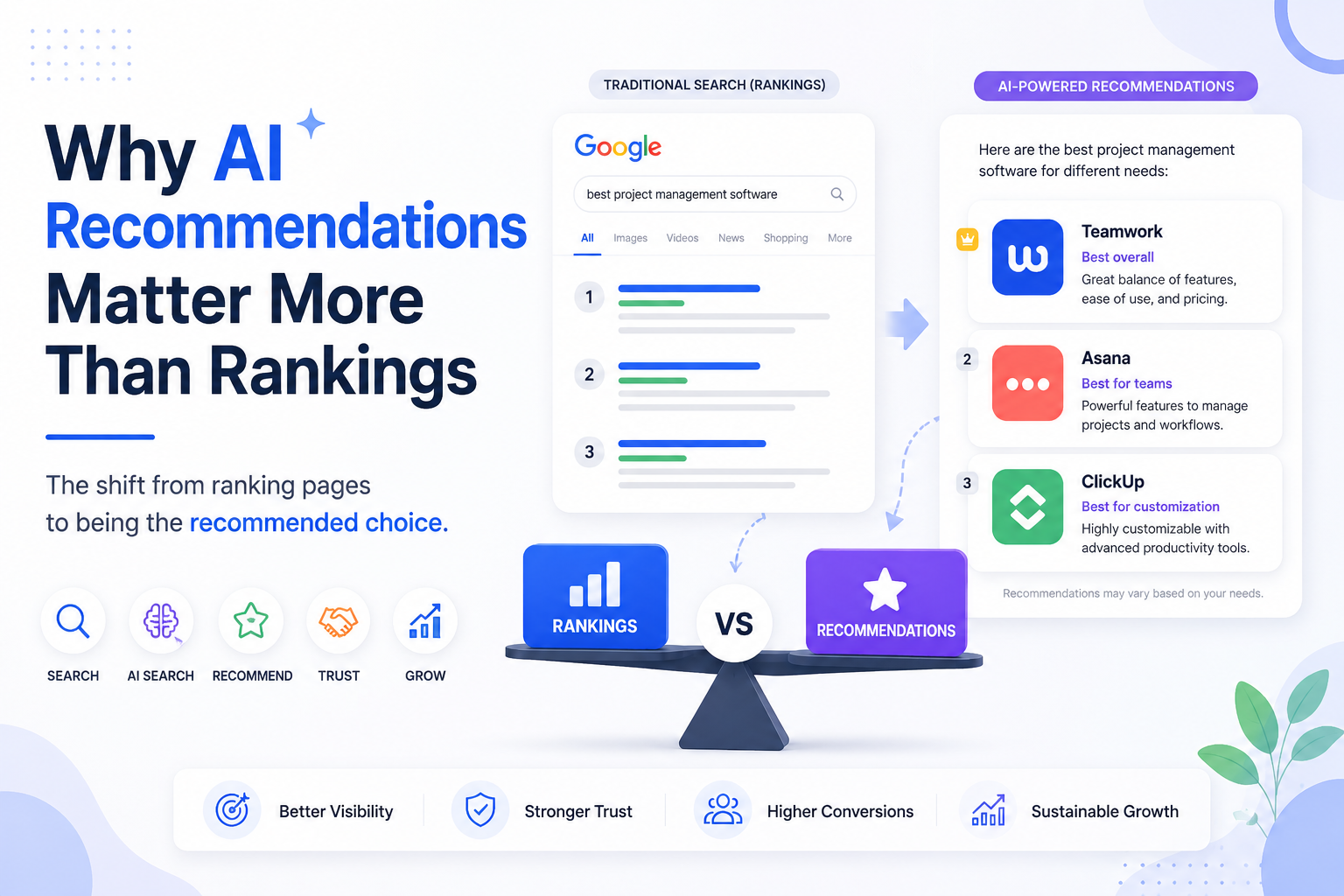
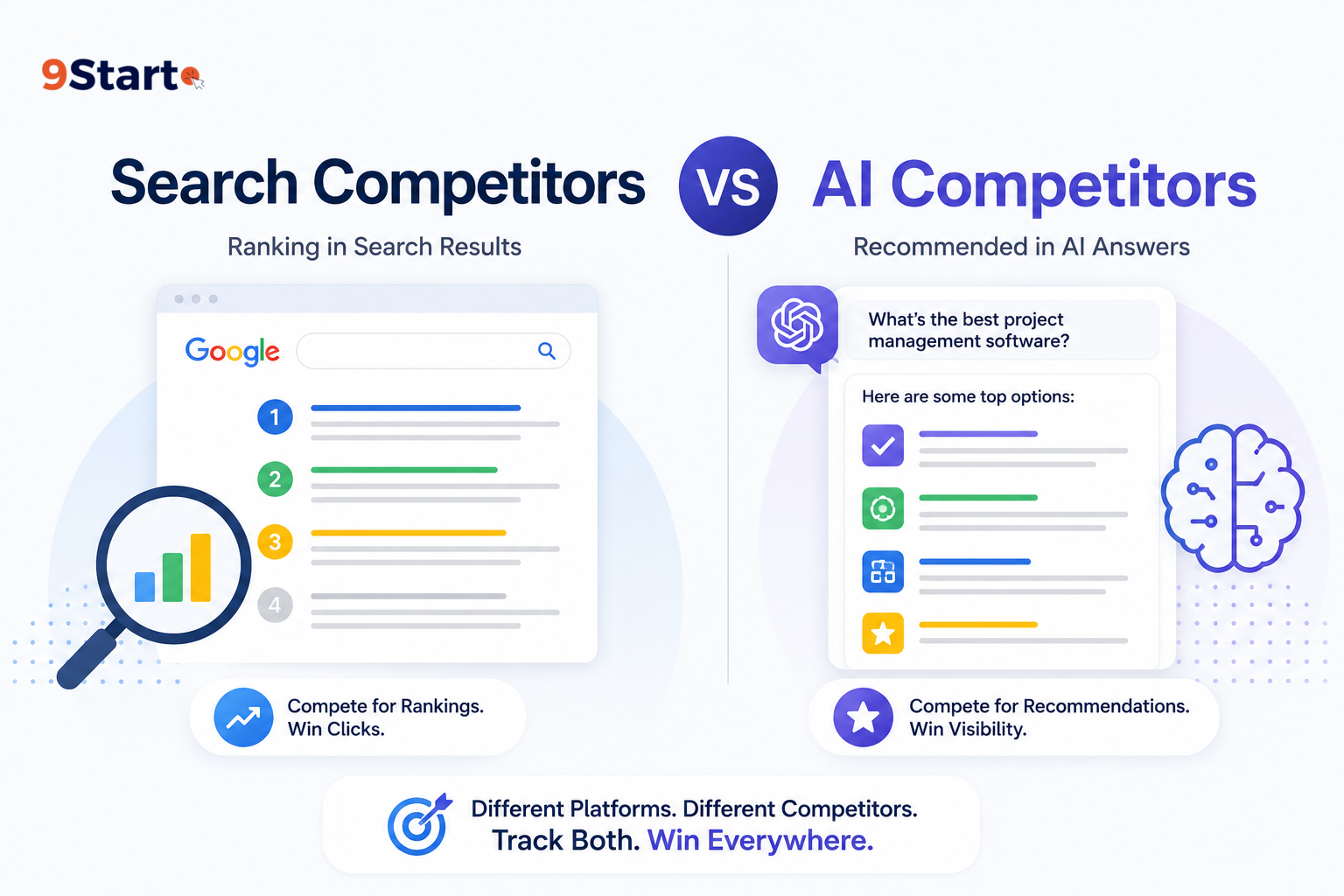
The real shift: from ranking to recommendation
The future of search isn’t simply about replacing Google rankings with AI prompts.
It’s about understanding the complete journey:
What does the customer search for?
What context are they searching in?
Which brands rank?
Which brands are recommended by AI?
Which competitors are gaining visibility?
Which pages are being cited?
And what can we do about it?
That’s why we believe SEO and AI visibility should be connected rather than treated as separate marketing disciplines.
DotSuite is built around that idea.
Final verdict
If your only requirement is:
“Tell me whether ChatGPT mentioned my brand.”
a dedicated AI visibility tracker may be enough.
But if you’re asking:
“How is my brand performing across Google Search and AI search, why are competitors winning, which contexts and prompts matter, and what should I do next?”
then you need a broader search intelligence workflow.
That’s where DotSuite stands out.
DotSuite connects Search + AI visibility in one platform, combining keyword tracking, Google Search performance, AI Overviews, AI visibility, competitor intelligence, prompt discovery, multi-market tracking, and AI Growth Copilot recommendations.
The objective isn’t simply to monitor whether AI recommends your brand.
It’s to understand why—and build the search visibility needed to earn that recommendation.

 ✦ AI Visibility